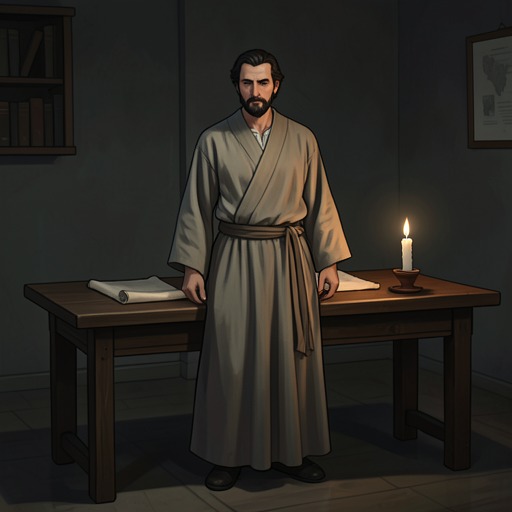
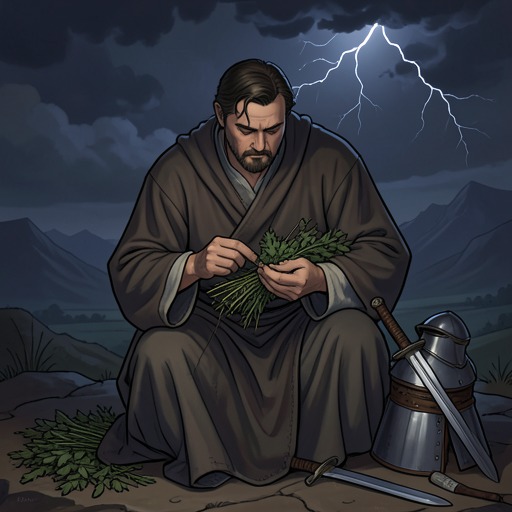
Green Dragon Sword
The Romance of the Three KingdomsThe Green Dragon Sword is the weapon most closely associated with Guan Yu in the cited episodes. In his hand it makes his battlefield authority visible: he uses it to kill Yan Liang and Cai Yang, carries it as he leaves Cao Cao’s service, and bears it when he confronts Cao Cao at Huarong. Its appearances mark not only feats of arms but also the changing claims of loyalty, gratitude, and righteousness that govern Guan Yu’s choices.
Identity and Narrative Function
The evidence presents the Green Dragon Sword as Guan Yu’s great sword, wielded alongside the horse Red Hare. It is not described through its construction or origin; its significance comes from what happens when Guan Yu carries it. The weapon repeatedly turns a confrontation into a decisive act, and its return across different episodes makes it a visual thread connecting service, separation, reunion, and mercy.
That recurrence gives the sword a role beyond equipment. It establishes Guan Yu’s capacity to act with overwhelming force, while the circumstances of each encounter show that force does not determine his decisions by itself. The same weapon that dispatches an opponent swiftly is present when Guan Yu chooses to let an enemy escape.
Yan Liang and Cao Cao’s Service
Cao Cao recognizes that Guan Yu may be the warrior capable of defeating Yuan Shao’s commander Yan Liang. Cheng Yu proposes that this opportunity might draw Guan Yu permanently to Cao Cao’s side: if Guan Yu kills a commander of Yuan Shao, he may become estranged from Xuande and have nowhere else to serve. Guan Yu is summoned, mounts Red Hare, and takes up the Green Dragon Sword.
He rides directly through the opposing force toward Yan Liang, who is unprepared for the sudden attack. With one stroke of the sword, Guan Yu kills him. He then takes Yan Liang’s head and returns to Cao Cao, carrying it on his reins. The shock of the action helps Cao Cao’s army rout the northern force and seize its supplies. The sword’s intervention thus has an immediate battlefield consequence, but it also sharpens the political tension around Guan Yu: the service Cao Cao can claim from him does not erase his attachment to Xuande.
When Cao Cao praises the feat as beyond the ability of an ordinary mortal, Guan Yu redirects the admiration toward Zhang Fei, saying his sworn brother could defeat a far larger army. Cao Cao’s officers are instructed to remember the warning. In this episode, the sword establishes Guan Yu’s exceptional fighting power, while his response makes clear that his identity is bound to his brothers rather than to the patron who has benefited from his victory.
Departure and Reunion
Guan Yu eventually attempts to leave Cao Cao and return to Xuande. After repeated efforts to see Cao Cao are frustrated, he recognizes that he is being prevented from fulfilling his promise. He leaves a letter of farewell at the prime minister’s gate and prepares to depart without keeping the gifts Cao Cao has given him, so that no charge of theft can be made against him.
He rides Red Hare, carries the Green Dragon Sword, and escorts the two women in their carriage out through the north gate. The weapon accompanies a deliberate break from Cao Cao’s service: Guan Yu leaves with the means to defend those traveling with him, but also with a clear effort to settle accounts honorably by leaving the gifts behind. His departure is therefore both an escape and a statement of allegiance.
The sword appears again at Gucheng, where Zhang Fei doubts Guan Yu’s account and demands proof. Cai Yang arrives with troops and accuses Guan Yu of murder, claiming that Cao Cao has ordered his arrest. Guan Yu does not answer with an explanation. He charges and kills Cai Yang before Zhang Fei has completed even one roll of the drums. The troops panic, but a captured junior officer reveals that Cao Cao’s force was actually headed for Runan and that Cai Yang had turned the accidental encounter into a personal pursuit. Zhang Fei questions the prisoner until he accepts that Guan Yu has told the truth. The sword’s swift stroke resolves the immediate danger, while the explanation that follows restores trust between the brothers.
The reunion does not end the search for Xuande. Guan Yu and Sun Qian travel to Runan, only to learn that Xuande has already left to consult Yuan Shao; they return disappointed to Gucheng and set out again. Because Guan Yu has killed two of Yuan Shao’s commanders, their attempt to reach Xuande in Yuan Shao’s territory carries additional danger, and secrecy becomes essential. The sword remains associated with Guan Yu’s readiness to fight, but the journey’s object is reunion, not conquest.
Huarong: Force and Restraint
At Huarong, the sword’s meaning turns on what Guan Yu declines to do. After Cao Cao’s retreat leaves him with only a small remnant of his force, Cao Cao encounters a roadblock led by Guan Yu, mounted on Red Hare and wielding the Green Dragon Sword. Cao Cao’s exhausted men are not in a condition to fight. Cheng Yu advises him to appeal personally to Guan Yu’s sense of virtue and to the kindness Cao Cao had shown him in the past.
Cao Cao also reminds Guan Yu that he killed Cao Cao’s officers while passing through the five gates during his escape. The appeal touches Guan Yu: he cannot dismiss either the earlier kindness or the deaths of the officers. Seeing the condition of Cao Cao’s men, he is moved by pity. He orders his troops to spread out along the road and turns his horse away, creating a gap through which Cao Cao and his officers ride to safety.
Guan Yu then confronts the remaining soldiers, but relents again when his old friend Zhang Liao rides forward. He lets the men go free. The scene gives the sword a strikingly different narrative function from its appearances at Yan Liang and Cai Yang: its presence makes the threat of decisive violence unmistakable, yet Guan Yu’s action is governed by honor, remembered obligation, and pity. Cao Cao’s retreat continues, but Guan Yu’s choice allows him to pass.
Recurring Significance
Across these episodes, the Green Dragon Sword accompanies both separation and fidelity. In Cao Cao’s service, it wins a battle and strengthens Cao Cao’s hopes of retaining Guan Yu; in Guan Yu’s departure, it travels with him as he leaves behind the gifts that might compromise his claim to act honorably; at Gucheng, it ends a confrontation before misunderstanding can harden into a lasting rupture. At Huarong, it stands beside the choice to spare the man it could have helped defeat.
The sword’s recurrence therefore ties martial prowess to ethical restraint without making the two identical. Guan Yu is able to act with exceptional speed and force, but the story’s decisive question is when he chooses to act and when he holds back. At Huarong especially, the weapon’s significance lies not in another victory but in the space Guan Yu opens for Cao Cao to escape.